
We make Bioponics productive.
Bioponics brings together the best of organic farming and hydroponics. Instead of relying on mineral fertilizers — which are energy-intensive to produce and can cause soil and water degradation — bioponics uses natural, organic nutrients to feed plants through a living ecosystem. Water is continuously recirculated, dramatically reducing consumption, while nitrogen leaching is avoided, protecting our waterways. Bioponics offers a sustainable, resilient, and regenerative way to grow — healthier for people, plants, and the planet.
What is Bioponics?
Bioponics is a way of growing plants without soil, using water enriched with natural, organic nutrients. Instead of relying on synthetic mineral fertilizers, bioponics draws its nutrients from regenerative sources like processed organic waste — such as food scraps, grass clippings, and other plant material. These materials are broken down by microbes into forms plants can easily absorb, creating a living, dynamic ecosystem within the water. Water is continuously recirculated, saving resources and preventing nutrient runoff. Bioponics offers a sustainable, future-ready alternative rooted in the cycles of nature.
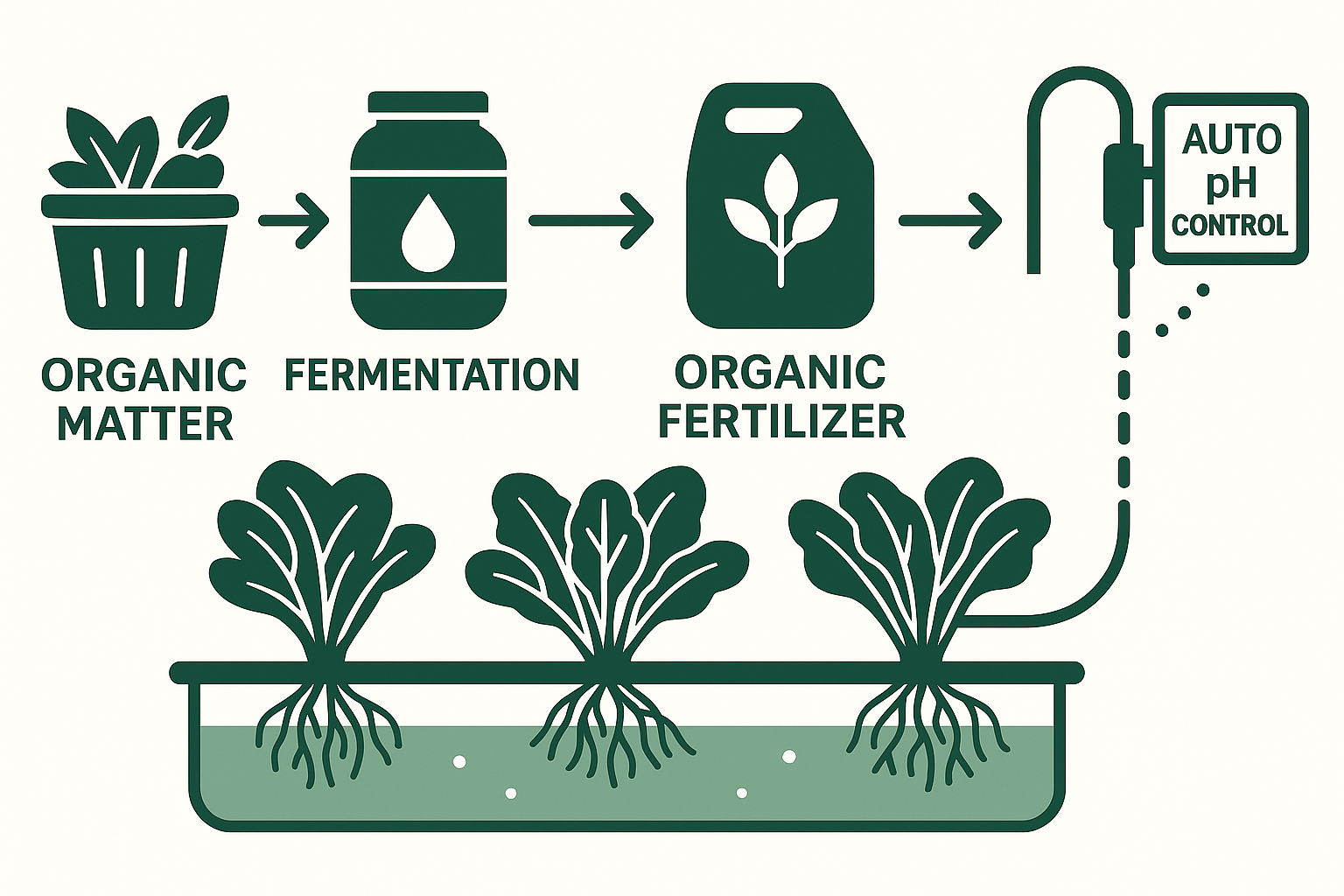
Organic residues—food scraps, grass clippings, spent crop leaves—are first converted into a nutrient-rich liquid by controlled anaerobic fermentation (sometimes called “bio-fertilizer brewing”). The fermented broth is then filtered and dosed into the recirculating water loop, where a thriving community of beneficial microbes continues to mineralize the nutrients so plant roots can take them up. Because the solution contains a complex mix of organic molecules, the usual hydroponic metric of electrical conductivity (EC) is an unreliable guide. Instead, bioponic systems rely on sensors such as pH (to track microbial activity and nutrient availability), dissolved oxygen (to keep roots and microbes healthy), oxidation-reduction potential (ORP, to spot anaerobic conditions), and sometimes nitrate or ammonium probes. Automated dosing and aeration are triggered when these sensors drift from their target ranges, ensuring plants receive just-in-time nutrition while the water stays balanced, clear, and highly water-efficient—without leaching or wasting precious nutrients.
Our Mission
We are a group of people dedicated to creating a sustainable, resilient future for food production. Our focus lies in advancing Bioponics and Aquaponics—innovative, soil-less growing methods that work with natural cycles to produce healthy, sustainable food.
Through continuous research, we explore how organic, closed-loop systems can meet the challenges of a changing climate. We share our insights openly, building knowledge-sharing hubs and hosting publications, talks, and workshops to empower farmers, communities, and innovators everywhere.
We also develop and maintain the technology needed to support these systems—always in an open-source spirit, so that everyone can access, adapt, and improve it freely.
Recognizing the need for broader change, we work closely with policy makers, offering expertise to help design food systems that are not only soil-less, but also organic, regenerative, and accessible to all.
Together, we believe we can build a food future that is sustainable, independent, and thriving—for people and for the planet.
Frequently Asked Questions
Shouldn’t we grow food on soil?
Healthy soil is essential for life on Earth, and protecting it is critical. However, industrial farming has already degraded much of the world’s arable land, and climate change is making traditional soil farming increasingly fragile. Bioponics offers a complementary solution: it produces food efficiently without depleting or polluting soil. By taking pressure off vulnerable farmland, bioponics can help protect and regenerate natural soils where they are most needed.
Isn’t it unsustainable to rely on all that technology?
At first glance, adding sensors, pumps, and controllers might seem like extra complexity. But in reality, bioponics uses technology to work with natural cycles, not against them. By recycling water, avoiding chemical fertilizers, and using organic waste streams as inputs, bioponics dramatically reduces the environmental footprint of farming. The technology is there to minimize waste, save energy, and preserve resources—essential steps in adapting to a world facing water scarcity, biodiversity loss, and climate disruption.
Do you also contribute to soil-based agriculture?
Absolutely. Although our primary showcase is soilless growing, much of our research directly benefits farmers working with soil. The fermentation protocols we use to turn food scraps and plant residues into liquid organic fertilisers can be applied as soil drenches, through drip irrigation, or even as seed and foliar treatments. Because these brews carry living microbes as well as slow-release nutrients, they help rebuild soil biology, boost humus formation, and cut the need for synthetic inputs.
The same circular-economy approach that feeds our bioponic loops also offers soil farmers a practical, home-grown alternative to mineral fertilisers—strengthening soils while closing local nutrient cycles.
What is new about Bioponics?
Bioponics takes the efficiency of hydroponics and replaces synthetic fertilizers with regenerative, living nutrient systems. It creates a dynamic microbial ecosystem in the water that mimics the natural soil food web, while using a fraction of the water and land. This combination—closed-loop organic nutrient cycling with high resource efficiency—is what makes bioponics a genuinely new and necessary evolution for sustainable agriculture.
Doesn’t Bioponics make farmers dependent on tech and other big money companies?
Not at all. In fact, bioponics is designed to empower farmers to be more independent. Systems can be built using open-source hardware and software, simple low-cost sensors, and locally sourced materials. Nutrients come from local organic waste, not from expensive chemical factories. Our vision is a food system where farmers and communities own and control the technology—and where food production is resilient, regenerative, and decentralized, rather than dominated by a handful of corporations.
How are you funding your work?
Our work is financed through a mix of co-op member equity, paid workshops and consulting, public research grants (EU Horizon Europe, German BMEL/BÖLN, etc.), and donations or impact investments from foundations and ethical banks. This blend keeps ownership in the community, aligns support with our open-source, climate-positive mission, and—crucially—lets us cover core costs so more of the team can dedicate their full energy to advancing Bioponics and related soil-building innovations. If you’d like to help speed things up, you can join the co-op, book a workshop, or contribute directly.